Are you prepared for this weekend’s roundup of Raspberry Pi initiatives? In the present day, I’ve some enjoyable issues so that you can check out, from constructing your individual data base to creating your individual customized feed reader, all earlier than Monday rolls round.
Create your individual fillable type on-line with DocuSeal
No have to pay DocuSign when DocuSeal works simply as nicely

If you happen to’ve ever run a bunch or needed to get paperwork signed earlier than, you then seemingly know the ache of making an attempt to do this. Having labored with church buildings my entire life, there’s all the time a doc to signal, it appears. Identical factor within the inventive world, from invoices to challenge scope and extra, PDFs all the time want one thing.
Usually, DocuSign is the go-to platform for digitally signing paperwork. It permits you to fill out a doc and signal it with out printing, which is superb. The issue is, DocuSign can get fairly costly.
That is why I am glad I discovered DocuSeal a number of years in the past. I used this once I was a youth pastor for fogeys to signal permission waivers, and it labored fantastically.
I merely uploaded a PDF, added textual content packing containers, date packing containers, and signature fields, then despatched the hyperlink to oldsters. It was extra handy for them, as teenagers could not lose the paper, and it was extra handy for us, as there was no paper to maintain observe of.
Launching DocuSeal in your homelab is fairly simple. It runs in Docker and could be usable inside only a few minutes. You do not want a scanner or something for it to work, both. All you want is the Pi, storage, and community entry. Every little thing else is dealt with remotely.
So, take a while this weekend and deploy DocuSeal in your homelab so you can begin streamlining doc dealing with with out having to pay a cent.
Construct an offline private data base with Trilium Notes
Arrange your ideas with out sending them to the cloud
There are lots of cloud-based note-taking suppliers on the market. The issue is, who actually owns that knowledge? What if that supplier shuts down? Can they learn your notes? There are lots of questions, and, far too usually, not sufficient solutions.
As a substitute of trusting your notes to a random third get together, it is best to simply host them your self. That is the place a Docker container known as Trilium Notes is available in. It is designed that will help you construct a private data base that homes issues like challenge documentation, reference supplies, and troubleshooting notes in your homelab multi functional place.
It affords a observe tree, inside hyperlinks, attachments, and search, so you’ll be able to set up and discover something you want inside your database. Plus, every thing is stored offline in your homelab, that means you’ll be able to nonetheless entry it even when the web goes down.
Merely deploy the Trilium Notes server in your Raspberry Pi and start setting every thing up. It’s going to be accessible solely regionally in your community at first, however you’ll be able to open it up behind a reverse proxy or one thing like Cloudflare Tunnels must you want distant entry to it.
Self-host your individual customized feed reader with Miniflux
Monitoring software program updates and social posts has by no means been simpler
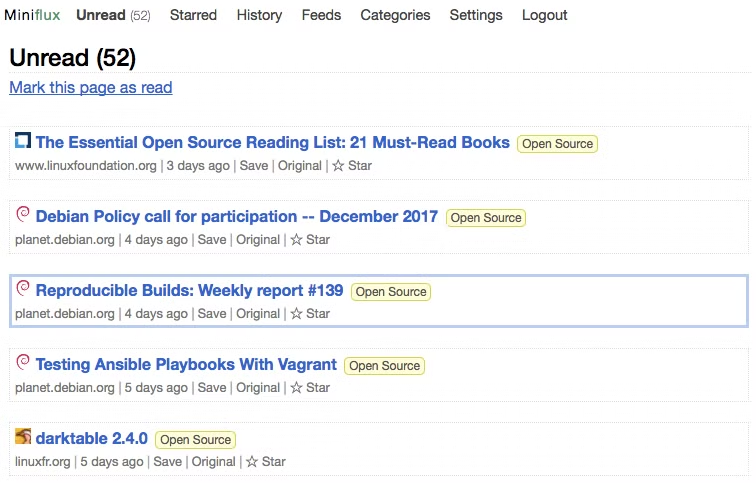
On the planet of algorithmic social feeds, you may simply need one thing that provides you a chronological (or customizable) feed of articles once more. That is what Miniflux is designed for.
Constructed to allow you to subscribe to RSS, Atom, or JSON feeds, Miniflux is the proper self-hosted feed reader to run in your homelab. It incorporates a browser-based studying interface, which suggests you’ll be able to entry it from any laptop inside your community, and even exterior the community should you set that up.
Simply load it onto an always-on Raspberry Pi working Docker, and it is able to go. You possibly can add your individual feeds to it, in addition to bookmark belongings you need to learn later, search, and construct out filters.
Miniflux can be an effective way to maintain up with software program releases and challenge bulletins that you just need to see multi functional place. Then, you could possibly create a separate feed space the place you pull within the newest movies out of your favourite YouTuber, or arrange RSS-bridge to herald X.com or Fb posts.
The most effective half about Miniflux is you are in 100% management of the feed. It is chronological and customised to suit your particular wants, in contrast to the algorithms current in nearly each different social feed on the market right this moment.
So, what are you ready for? Deploy Miniflux right this moment and regain some sanity in a world stuffed with AI-powered feeds.
Your Pi is without doubt one of the greatest items of homelab tech you might have
In the present day’s put up targeted a bit extra on homelab initiatives than regular Raspberry Pi initiatives, and that is as a result of the Raspberry Pi is a implausible homelab companion. It is comparatively low cost, fairly succesful, and ultra-low-power in comparison with working a desktop.
So, should you’ve been eager to dip your toes within the homelab waters and have a spare Pi sitting round, now’s the proper time to attempt it out!